I put off posting for the last few days so that I get the last post while we are in South America. Unless Sarah puts one up in the next two hours, this is it. What an awesome trip. I love traveling like this: experiencing new things, pushing boundries, doing things never previously contemplated. Sarah has done a lot that neither of us thought that she would ever do... climbing a volcano for example, or eating a ridiculous amount of fried eggs. All in all, it has been fantastic. Also, the opportunity to share some of this experience (although at a much higher comfort level) with our parents and siblings was really nice.
The last week in South America:
We met Tristan in Arica and showed him around town, that was all covered in Sarah's post. We got on an overnight bus to San Pedro de Atacama last wednesday for a few days of spending lots of money and going on cool tours around the desert and the antiplano. We arrived, after a wonderful (pill-induced) sleep on the bus, ready to conquer the desert. So for the first day, after grabbing some lunch, we joined a tour group out to the Valley of Death and Valley of the Moon. Wow. The valley and rock formations were unbelievable. There were also huge sand dunes for sandboarding (which we unfortunately did not do while in San Pedro) that we ended up running and rolling down. We caught the sunset in the Valley of the Moon and it was really beautiful.
We woke up the next morning at 4 AM to head out to the geysers. We were there for the sunrise and it was gorgeous. I felt a little altitude sickness since we went up more than 2000 meters in about 3 hours but it was still awesome. To see water shooting up out of the ground while the sun is coming up over the mountain tops immediately behind the geysers was something unbelievable. There were also natural hot springs that some people chose to swim in. We ate breakfast out there and made our way back to San Pedro relatively slowly, making various stops to see vicuñas, flamingos and traditional villages. We rested for the afternoon for the next day's adventure.
The next morning we got a small group tour with a Brazilian couple out to the salt lakes in the Atacama salt flat. We went swimming in the lakes and it was really cool to float in the extremely salty water. It was actually difficult not to float and it was a really odd sensation since it was so different from all my other experiences in water. The salt flats were awesome, whiteness stretching out into the desert and the water was still enough that clear reflections of ourselves and the mountains could be seen really easily. We got a great lunch at the last lake of olives, cheese, salami, crackers and wine, all included in our little private tour.
After that indulgence, we got on the evening bus headed toward Santiago. We got off the bus the next day in La Serena to hang out for a couple of hours. We checked out the archeology museum that we missed our first time through, spent some time in the market, and met a really cool old lady who was selling a bunch of leftist documentaries, movies and music made about and after the coup here in Chile. We then got back on a later bus and made our way back to Santiago.
We have been in Santiago for the last few days, trying to make the most of our time here. Since we hadn't really seen the city much, we did a lot of sightseeing. We went to La Moneda (the presidential palace) and checked out the civic center below it. We went to the Salvador Allende museum which is definitely one of the top 5 museums that we have seen this trip. We walked around Bellavista and ate good food and drank good wine. We went on winery tours at Cousiño-Macul and at Concha Y Toro, both of which were rather touristy, but good to see since Tristan had never been to a winery before. And we hung out at the house and relaxed after 2 weeks of really long bus rides and moving around a lot in Northern Chile.
Everyone here has been so awesome to us. Starting in Ecuador with Ricardo's family, the hospitality has been incredible and we owe our good time spent here to the families that put us up and helped us out. Also, thanks again to our parents who first agreed to this trip and for helping make it possible. And finally, the people that we met around South America made for some great company and good stories. I really hope to do this again in the not too distant future. It is sad to go home, but I have to get back to school and Sarah needs a job. So it goes.
Wednesday, January 16, 2008

Wednesday, January 9, 2008
Living in the desert
We've been in northern Chile for quite a few days now, and it is without a doubt way different than the rest of this crazy country. Everything is desert, so while our bus rides (which are extremely long since towns are quite a ways away from each other) have not offered the most exciting scenery, it's pretty cool to see the land stretch on and on for kilometers. That being said, it's extremely hot, and the sun is killer.
We stayed in Iquique for a couple of days but weren't too impressed by it. The beach was pleasant enough, though a bit too crowded. We weren't the lazy beach bums we had hoped to be since the sun is brutal on the skin after just 2 hours (even with SPF 60). Thankfully, there is a really great pedestrian street, Baquedano, that leads to the main plaza and is host to fun restaurants and bars. It's pretty quaint, with the old trolley tracks still in place, an out-of-use trolley car sitting patiently on the street, and cobblestone. The rest of the town is a bit more rough-and-tumble, so Eben and I were perfectly content to spend most of our time around Baquedano.
Arica, which is at the very top of Chile, is a bit more gratifying. The beach here is small but clean, and even though we only went there briefly yesterday, I liked it way better than Iquique. We're staying at a friendly hostel outside of the center, so it's a bit of a hike to get anywhere. The people are wonderful, though, so it's worth it. On Monday Eben and I went down to the fish market to see the massive sea lions twirling in the water waiting for fish to be thrown down to them. It's the closest we've ever gotten to sea lions, so we were able to really appreciate how big these guys are. The market is also close to the main plaza, so we checked out the town's church (constructed entirely out of iron and designed by Eiffel) and the old Customs building. Yesterday morning we went to the archeological museum, which has fantastic artifacts from the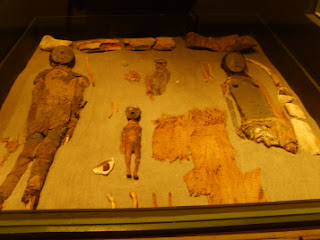 civilizations that used to inhabit the area thousands of years ago. On display are four very interesting Chinchorro mummies. The bodies are essentially emptied of their organs (even the brain!) and covered in mud. I've read that sometimes even the skin was removed (I wouldn't want that job). The climate is so extremely dry and hot here that they are really small from dehydration, yet otherwise greatly preserved. They're also the oldest examples of mummifications, predating Egyptian mummies by thousands of years. Pretty cool! After the museum we checked out the nearby geoglyphs, which were a bit anticlimactic. Oh well.
Later in the afternoon, Tristan arrived! He has been in Perú with his dad, conquering the Peruvian Amazon and the Inca Trail to Machu Picchu. Hearing him talk about it has made me pretty jealous, I'll admit, so I have a feeling that Eben and I will be returning to Perú in the near future (maybe when I get a real job! woo!!!) to cover that territory. At any rate, it's nice to have Tristan with us, and I'm sure Eben is happy to have a boy around after being trapped with me for the past five months. :) We gave Tristan the tour of Arica today, returning to the museum and plaza and all of that. We leave tonight for San Pedro. The bus ride is about 12 hours long (overnight), so we will hopefully arrive around 10 in the morning. The buses have been pretty hot and sweaty up here in the North, as few have windows that open, and the crew neglects to turn on the air. I truly believe these people are sadists.
Sooooo, in conclusion, northern Chile is pretty interesting after having seen the rest of the country. We've done glaciers, vineyards, lakes, and now desert. What a crazy country! The downside to the North is that bus tickets are crazy expensive (I won't even reveal how many times I've had to withdraw large amounts from the ATM in the past week, but use your imagination. Yes, it's that bad.) since distances are so long and bus companies can charge whatever they want. It's cruel, yes. Overall this region doesn't have too much to offer, though it really is a cool experience. San Pedro is the adventure center of the North, so I think we'll have more fun when we get there.
And on a side note, did anyone else know that Bolivia now requires U.S. citizens to apply for a visa? It's nuts. $100, plus passport-sized photos against a red background, proof of "sufficient funds," proof that you have somewhere to stay... and you can only enter the country a maximum of 3 times per year, and the total stay cannot exceed 90 days. It's so frustrating!!! I understand this is reciprocity, that the United States does the exact things to Bolivians, but it's still frustrating. Mostly the 90-day thing. As it was when Eben and I were there, you could ask for a 90-day tourist stamp, cross the border into a neighboring country on Day 90, and go right back for another 90 days. No more, my friends, no more. These new laws won't stop me from returning to Bolivia in the future, but it's just a big pain. But ultimately, the United States deserves it. Chile charges $100 to U.S. citizens arriving in the country by plane, Brazil charges about $200 in visa fees, and now Bolivia. Listening to the stories we heard over breakfast this morning from some non-U.S. travelers, I conclude that our country sucks. The amount of red tape and inane requirements for visas, green cards, etc. is disgusting. It shouldn't be such a stupid process. Yet it is, and that's why Bolivia is now doing this. I consider moving to a different country more and more seriously every day.
And on that anti-patriotic, slightly vitriolic note, I'm off. :) Happiness!
We stayed in Iquique for a couple of days but weren't too impressed by it. The beach was pleasant enough, though a bit too crowded. We weren't the lazy beach bums we had hoped to be since the sun is brutal on the skin after just 2 hours (even with SPF 60). Thankfully, there is a really great pedestrian street, Baquedano, that leads to the main plaza and is host to fun restaurants and bars. It's pretty quaint, with the old trolley tracks still in place, an out-of-use trolley car sitting patiently on the street, and cobblestone. The rest of the town is a bit more rough-and-tumble, so Eben and I were perfectly content to spend most of our time around Baquedano.
Arica, which is at the very top of Chile, is a bit more gratifying. The beach here is small but clean, and even though we only went there briefly yesterday, I liked it way better than Iquique. We're staying at a friendly hostel outside of the center, so it's a bit of a hike to get anywhere. The people are wonderful, though, so it's worth it. On Monday Eben and I went down to the fish market to see the massive sea lions twirling in the water waiting for fish to be thrown down to them. It's the closest we've ever gotten to sea lions, so we were able to really appreciate how big these guys are. The market is also close to the main plaza, so we checked out the town's church (constructed entirely out of iron and designed by Eiffel) and the old Customs building. Yesterday morning we went to the archeological museum, which has fantastic artifacts from the
 civilizations that used to inhabit the area thousands of years ago. On display are four very interesting Chinchorro mummies. The bodies are essentially emptied of their organs (even the brain!) and covered in mud. I've read that sometimes even the skin was removed (I wouldn't want that job). The climate is so extremely dry and hot here that they are really small from dehydration, yet otherwise greatly preserved. They're also the oldest examples of mummifications, predating Egyptian mummies by thousands of years. Pretty cool! After the museum we checked out the nearby geoglyphs, which were a bit anticlimactic. Oh well.
Later in the afternoon, Tristan arrived! He has been in Perú with his dad, conquering the Peruvian Amazon and the Inca Trail to Machu Picchu. Hearing him talk about it has made me pretty jealous, I'll admit, so I have a feeling that Eben and I will be returning to Perú in the near future (maybe when I get a real job! woo!!!) to cover that territory. At any rate, it's nice to have Tristan with us, and I'm sure Eben is happy to have a boy around after being trapped with me for the past five months. :) We gave Tristan the tour of Arica today, returning to the museum and plaza and all of that. We leave tonight for San Pedro. The bus ride is about 12 hours long (overnight), so we will hopefully arrive around 10 in the morning. The buses have been pretty hot and sweaty up here in the North, as few have windows that open, and the crew neglects to turn on the air. I truly believe these people are sadists.
Sooooo, in conclusion, northern Chile is pretty interesting after having seen the rest of the country. We've done glaciers, vineyards, lakes, and now desert. What a crazy country! The downside to the North is that bus tickets are crazy expensive (I won't even reveal how many times I've had to withdraw large amounts from the ATM in the past week, but use your imagination. Yes, it's that bad.) since distances are so long and bus companies can charge whatever they want. It's cruel, yes. Overall this region doesn't have too much to offer, though it really is a cool experience. San Pedro is the adventure center of the North, so I think we'll have more fun when we get there.
And on a side note, did anyone else know that Bolivia now requires U.S. citizens to apply for a visa? It's nuts. $100, plus passport-sized photos against a red background, proof of "sufficient funds," proof that you have somewhere to stay... and you can only enter the country a maximum of 3 times per year, and the total stay cannot exceed 90 days. It's so frustrating!!! I understand this is reciprocity, that the United States does the exact things to Bolivians, but it's still frustrating. Mostly the 90-day thing. As it was when Eben and I were there, you could ask for a 90-day tourist stamp, cross the border into a neighboring country on Day 90, and go right back for another 90 days. No more, my friends, no more. These new laws won't stop me from returning to Bolivia in the future, but it's just a big pain. But ultimately, the United States deserves it. Chile charges $100 to U.S. citizens arriving in the country by plane, Brazil charges about $200 in visa fees, and now Bolivia. Listening to the stories we heard over breakfast this morning from some non-U.S. travelers, I conclude that our country sucks. The amount of red tape and inane requirements for visas, green cards, etc. is disgusting. It shouldn't be such a stupid process. Yet it is, and that's why Bolivia is now doing this. I consider moving to a different country more and more seriously every day.
And on that anti-patriotic, slightly vitriolic note, I'm off. :) Happiness!
Thursday, January 3, 2008
From the Lakes to the Desert
So it is 2008 and we are back on our own. As Sarah said, it was really nice to have our parents with us and we really enjoyed the holidays down in Puyehue. But it was time to move on to northern Chile and the new year. First stop: La Serena. We arrive on a Sunday and (big surprise) everything is closed except for the last tour of the year at the Mamalluca observatory. This part of Chile has nearly 340 clear nights per year so it is a prime location for astronomical research. The observatory that we visited was just for tourists though and all the tour guides are Chilean astronomers who also do their own research and everything. It was really cool, a beautiful night and really nice guide who explained lots of stuff about the stars, showing us constellations and planets, had us look through different telescopes of different magnitude and showed us some of his own work and some photographs that he has taken. And, since we are in the Pisco producing region of Chile, we finished the tour with our driver giving everyone in our van a pisco sour for the ride back to La Serena. The next day was New Years Eve and although the town was pretty busy in the morning, it was dead and closed by 8 PM when we wanted to have the last dinner of 2007. It was not a memorable dinner but the rest of the night was great. We hung out with a German guy and his Polish wife who both work for Adidas and an Austrian woman who accompanied us to the beach. With bottles of champagne in hand, we watched three fireworks displays similtaneously as 2007 became 2008. There was the really big one that was just to our right and that was put on by the city of La Serena and then there were two others in different spots along the horseshoe bay that encompassed a few cities. It was awesome and a great way to start the new year.
The next day we went to Copiapo, a cute town a few hours further north. Of course, not much was happening on the 1st, so we chilled in the plaza and walked around for the afternoon. The next day, we checked out the mineralogical museum, quite possibly the most comprehensive in Chile because this is a big mining area and the university here specializes in geology. It was pretty cool and again, the rest of the day was spent walking around and chilling out.
It is now the 3rd and we are in Antofagasta, the city that was hit by an earthquake in November (although it doesn't show it where we are staying). It is the major port here for exporting the minerals mined from northern Chile. Hence it is a bustling place with a mix of new buildings and historic customs houses and whatnot from the late 1800s.
I think that we may be going to a movie tonight at the brand new movie theater. Then tomorrow we move further north to another port town/surfer hangout called Iquique. Then we are meeting up with my brother again in a few days when he is done with the Inca Trail. Frankly, I am a little jealous that he is doing that and we didn't, but he has also been in school all semester, so whatever. It will be cool to see him again regardless. Until then...
The next day we went to Copiapo, a cute town a few hours further north. Of course, not much was happening on the 1st, so we chilled in the plaza and walked around for the afternoon. The next day, we checked out the mineralogical museum, quite possibly the most comprehensive in Chile because this is a big mining area and the university here specializes in geology. It was pretty cool and again, the rest of the day was spent walking around and chilling out.
It is now the 3rd and we are in Antofagasta, the city that was hit by an earthquake in November (although it doesn't show it where we are staying). It is the major port here for exporting the minerals mined from northern Chile. Hence it is a bustling place with a mix of new buildings and historic customs houses and whatnot from the late 1800s.
I think that we may be going to a movie tonight at the brand new movie theater. Then tomorrow we move further north to another port town/surfer hangout called Iquique. Then we are meeting up with my brother again in a few days when he is done with the Inca Trail. Frankly, I am a little jealous that he is doing that and we didn't, but he has also been in school all semester, so whatever. It will be cool to see him again regardless. Until then...
Friday, December 28, 2007
Back in Santiago
We're back in Santiago and back to being vagabonds. Our time with our families in Puyehue was lovely, and it was a great way to spend the holidays. It was just so relaxing, and with everyone free to spend their time however they wanted, I think everyone had a great time. And we drank an absurd amount of wonderful Chilean wine, which keeps everyone in high spirits! Christmas morning (which was also Tristan's birthday) we went ziplining over the forest. It was a lot of fun to zoom over the river and trees, though I'll admit I had visions of myself crashing into a tree. But if I can roll down a volcano with an ice pick in hand, I can certainly fly over a forest in a harness. We spent our last full day down at the lake (Lake Puyehue), kayaking and navigating the paddle boats. Luisa and I could work on our steering a bit more, as at one point we crashed into a giant buoy. Oops. :) On our way back to Puerto Montt, where our flight back to Santiago was from, we all stopped in Puerto Varas for lunch and wandering. It was nice to go back to that town, as Eben and I didn't get to spend too much time when we were last there.
At any rate, here we are again. Tristan and his dad left way early this morning to conquer the Peruvian Amazon, Eben's mom leaves for Australia tonight, and my family goes back to New York tonight. So we'll be left alone again and resume our lifestyle of living off of empanadas and cheese.


At any rate, here we are again. Tristan and his dad left way early this morning to conquer the Peruvian Amazon, Eben's mom leaves for Australia tonight, and my family goes back to New York tonight. So we'll be left alone again and resume our lifestyle of living off of empanadas and cheese.
I think seeing my family again made me realize how much I do miss them. We only have a couple more weeks left in Chile, and then I'll be home! Eben and I leave tomorrow for northern Chile, our first stop being the beach town of La Serena. Since this leg of the journey has pretty much been aimless wandering, I am of course starting to feel restless and in need of a project. It'll be good to feel busy again. But until then, I can learn how to surf in Chile. :)
And since 2007 is coming to an end, I just wanted to reflect on some things I'm really proud of since we first landed in Ecuador.
1. Going to the southern hemisphere for the first time... and straddling the Equator, simultaneously being in the North and South!
2. Machu Picchu
3. Crawling through the silver mines of Potosí, Bolivia
4. Navigating our way through the bus barricades of Potosí and Sucre, Bolivia
5. Seeing Patagonian glaciers
6. Climbing up the 2080-meter-high Volcán Villarrica and sliding all the way down
7. Ziplining over Parque Nacional Puyehue
And of course there have been the countless treks up intimidating mountainsides, learning that I can indeed live out of a backpack for 5 months, and proving to myself that even though certain people didn't think I was tough enough for this, I did it all anyway.
Monday, December 24, 2007
Merry Christmas!
I'll try to make this entry short and sweet. The rest of our time in Viña was really nice. It's a cute beachside town and popular vacation destination for Chileans and Argentines. We were unexpectedly awoken by small earthquake tremors one morning, which was a bit scary, but it didn't do any damage by us. Other than wandering around the town, we also did an afternoon of wine tasting in the Casablanca Valley, which was pretty sweet. More details in another post. We headed back to Santiago to meet my mom and Eben's brother, Tristan, and on Friday we all headed down to the Lake District to spend the holiday together!
We are now in Puyehue, staying at a very nice resort and being pampered like never before. :) Our days are basically a whirl of massages, hiking, swimming in one of the many pools (some are heated!), and horseback riding. Yay! It's fun to be together with our families (and Luisa's best friend from Vassar, Norma, and her husband, Kevin) and just spend this holiday doing fun things and relaxing. Our families head off a bit after Christmas, and then Eben and I are on our own again. Tristan will meet up with us again after he does the Inca Trail with his dad in Perú, and we'll explore northern Chile before heading back to Santiago to fly home! The time is flying by so fast!!!
We are now in Puyehue, staying at a very nice resort and being pampered like never before. :) Our days are basically a whirl of massages, hiking, swimming in one of the many pools (some are heated!), and horseback riding. Yay! It's fun to be together with our families (and Luisa's best friend from Vassar, Norma, and her husband, Kevin) and just spend this holiday doing fun things and relaxing. Our families head off a bit after Christmas, and then Eben and I are on our own again. Tristan will meet up with us again after he does the Inca Trail with his dad in Perú, and we'll explore northern Chile before heading back to Santiago to fly home! The time is flying by so fast!!!
Monday, December 17, 2007
Parents!
Ok, so the parents are here and life is good. A brief synopsis of what happened before they got here and then what we have been doing.
From Santa Cruz we went out to visit Montes Winery. We had a private tour with a very nice tourguide who gave us some of the premium wine to taste even though it was not included. The whole winery is built feng shui with music playing in the barrel room and all the energy flowing out of a fountain in the center of the winery. It is really cool. The wine was fantastic and we tasted four kinds: a cabernet sauvignon/carmenere blend, a cabernet sauvignon, a syrah and their premium wine the M. All were very good and are all exported to the states. We also had an awesome cab driver who pointed out all sorts of things inside and outside of the city on the way to the winery such as what school he went to and what different fruits and vegetables were growing in the countryside. It was a good day.
The next day we moved on to Pichilemu, the surf destination of Chile. We spent the day on the beach getting tan and also eating empanadas that are awesome and cheap. The beach is gorgeous, black sand stretching as far as the eye can see with big waves breaking over the sandbars out in the horseshoe bay. We relaxed the first day and then on the second day I took surf classes. In the morning was pretty difficult since we were out deep, the tide was high and the waves were big. It was only me and a 20 year old instructor who had been surfing his whole life. He was great. Then in the afternoon, I went out with him again and a few more people and it was much easier. We were catching the beach breaks and I actually made it up and stayed with the wave a few times. Hopefully this will happen more as we move up the northern coast of Chile in January.
Sarah is a friend of dogs. While I was surfing, she managed to befriend at least 3 stray dogs who joined her while tanning on the beach. One even followed us all over town, waiting for us while we did internet and everything. It was very cute.
Then the parents arrived. The last few days have been filled with food, touring and lots of wine. From barbeques in Santiago to cooking dinner in Viña del Mar, we are living the life. We have been staying with the sister of Sarah's dad in Santiago. It is a huge family and a huge estate and it was all parties with bbqs, paellas, going out to salsa and everything. We are in Viña del Mar right now at her other apartment. This is a seaside resort next to Valpairiso and is gorgeous. We have spent the last few days sightseeing during the day and having wonderful dinners and wonderful wine at night. Tomorrow we are going for a winery tour and lunch at Viña Casas del Bosque. My brother and Sarah's mom are arriving soon and we really look forward to it.
Life is good.
From Santa Cruz we went out to visit Montes Winery. We had a private tour with a very nice tourguide who gave us some of the premium wine to taste even though it was not included. The whole winery is built feng shui with music playing in the barrel room and all the energy flowing out of a fountain in the center of the winery. It is really cool. The wine was fantastic and we tasted four kinds: a cabernet sauvignon/carmenere blend, a cabernet sauvignon, a syrah and their premium wine the M. All were very good and are all exported to the states. We also had an awesome cab driver who pointed out all sorts of things inside and outside of the city on the way to the winery such as what school he went to and what different fruits and vegetables were growing in the countryside. It was a good day.
The next day we moved on to Pichilemu, the surf destination of Chile. We spent the day on the beach getting tan and also eating empanadas that are awesome and cheap. The beach is gorgeous, black sand stretching as far as the eye can see with big waves breaking over the sandbars out in the horseshoe bay. We relaxed the first day and then on the second day I took surf classes. In the morning was pretty difficult since we were out deep, the tide was high and the waves were big. It was only me and a 20 year old instructor who had been surfing his whole life. He was great. Then in the afternoon, I went out with him again and a few more people and it was much easier. We were catching the beach breaks and I actually made it up and stayed with the wave a few times. Hopefully this will happen more as we move up the northern coast of Chile in January.
Sarah is a friend of dogs. While I was surfing, she managed to befriend at least 3 stray dogs who joined her while tanning on the beach. One even followed us all over town, waiting for us while we did internet and everything. It was very cute.
Then the parents arrived. The last few days have been filled with food, touring and lots of wine. From barbeques in Santiago to cooking dinner in Viña del Mar, we are living the life. We have been staying with the sister of Sarah's dad in Santiago. It is a huge family and a huge estate and it was all parties with bbqs, paellas, going out to salsa and everything. We are in Viña del Mar right now at her other apartment. This is a seaside resort next to Valpairiso and is gorgeous. We have spent the last few days sightseeing during the day and having wonderful dinners and wonderful wine at night. Tomorrow we are going for a winery tour and lunch at Viña Casas del Bosque. My brother and Sarah's mom are arriving soon and we really look forward to it.
Life is good.
Tuesday, December 11, 2007
Penguin and glacier photos!!
Just a brief highlight of our journeys down south because we finally burned the gig memory card onto a DVD.
 Penguins on a beach! Penguins on a beach!
 More penguins!
 Sea lions lounging
Our first attempt to trek through the snow... posing with the glacier sign!
 Yay icebergs!
We of course have a lot more, but the internet here is too slow to upload more. But this gives you an idea!
Monday, December 10, 2007
Volunteer tourism
So I have just read Jennifer Conlin's article in the NY Times entitled, "Trips to Help Shape the World." It's briefly about volunteer vacations and these newish organizations that organize one-week (or more) excursions to some underdeveloped country, where you do some volunteer work and go on sightseeing tours withyour own guide and everything. It's a new twist on tourism intended to promote a sense of goodwill while still maintaining your tourist status.
Now, while I have certainly done a good share of sightseeing and relaxation on this trip, I feel like these volunteer vacations are contradictory and frustrating to anyone seeking viable volunteer options. Spend a week playing an African orphan and then dine in a 4-star restaurant? This is completely ridiculous. Organizations like Cross-Cultural Solutions ask that you pay thousands of dollars to spend a week in a location, not including airfare. Who can afford that? The people who actually want to do some good in a place can't just hand over $3000 for a 2-week placement. That's a 3-month budget for me. And forget about doing a long-term placement with one of these organizations. A 3-month placement with Cross-Cultural Solutions costs nearly $6000.
Furthermore, our great frustration with LIFE Argentina was that there was absolutely no continuity. Children who live in unstable environments need continuity, and they need to know that friendly faces don't just come and go every few days. While I think that some help and some support is better than no help and no support, long-term placements are ultimately going to be the best. The volunteer gets to establish a solid connection with the community he/she is working in, and the people become familiar with the volunteer and hopefully will learn to trust and respect that figure. These programs seem to ignore that basic principle, and at times the volunteer component of these "vacations" seems to be an afterthought. Volunteering shouldn't be a frivolous expense.
I think what my biggest problem with "volunteer vacation" organizations (sorry, Cross-Cultural Solutions, but you are getting the brunt of my disgust) is that at the present moment, these are the most publicized and easiest ways to volunteer abroad. (Volunteer South America is a great resource for free and low-cost options.) There is a severe lack of information about organizations that don't charge thousands of dollars for your services (and keep that in mind, CCS charges thousands of dollars for your mere presence in an underdeveloped country), and I fear that this is because there is also a lack of such organizations in general. What angers me the most is that while these organizations maintain that such high costs are necessary because they benefit the community you are working in, as well as pay for your food and housing (though not always), Eben and I know for a fact that such costs are completely unnecessary. Inti Runakunaq Wasin in Cusco, Peru, asks for a $50 donation, regardless of how long you stay (coincidentally, most volunteers are long-term). What exactly is CCS (and LIFE Argentina, for that matter) spending its money on? I smell a rat.
In a nutshell, if you're looking for a different sort of family vacation and happen to have an actual income that affords you the luxury of dropping several thousand dollars, then an organization like CCS can probably offer a neat way to spend your vacation. But if you want to do actual volunteer work, then these organizations are money-suckers that do little good for the world.
Now, while I have certainly done a good share of sightseeing and relaxation on this trip, I feel like these volunteer vacations are contradictory and frustrating to anyone seeking viable volunteer options. Spend a week playing an African orphan and then dine in a 4-star restaurant? This is completely ridiculous. Organizations like Cross-Cultural Solutions ask that you pay thousands of dollars to spend a week in a location, not including airfare. Who can afford that? The people who actually want to do some good in a place can't just hand over $3000 for a 2-week placement. That's a 3-month budget for me. And forget about doing a long-term placement with one of these organizations. A 3-month placement with Cross-Cultural Solutions costs nearly $6000.
Furthermore, our great frustration with LIFE Argentina was that there was absolutely no continuity. Children who live in unstable environments need continuity, and they need to know that friendly faces don't just come and go every few days. While I think that some help and some support is better than no help and no support, long-term placements are ultimately going to be the best. The volunteer gets to establish a solid connection with the community he/she is working in, and the people become familiar with the volunteer and hopefully will learn to trust and respect that figure. These programs seem to ignore that basic principle, and at times the volunteer component of these "vacations" seems to be an afterthought. Volunteering shouldn't be a frivolous expense.
I think what my biggest problem with "volunteer vacation" organizations (sorry, Cross-Cultural Solutions, but you are getting the brunt of my disgust) is that at the present moment, these are the most publicized and easiest ways to volunteer abroad. (Volunteer South America is a great resource for free and low-cost options.) There is a severe lack of information about organizations that don't charge thousands of dollars for your services (and keep that in mind, CCS charges thousands of dollars for your mere presence in an underdeveloped country), and I fear that this is because there is also a lack of such organizations in general. What angers me the most is that while these organizations maintain that such high costs are necessary because they benefit the community you are working in, as well as pay for your food and housing (though not always), Eben and I know for a fact that such costs are completely unnecessary. Inti Runakunaq Wasin in Cusco, Peru, asks for a $50 donation, regardless of how long you stay (coincidentally, most volunteers are long-term). What exactly is CCS (and LIFE Argentina, for that matter) spending its money on? I smell a rat.
In a nutshell, if you're looking for a different sort of family vacation and happen to have an actual income that affords you the luxury of dropping several thousand dollars, then an organization like CCS can probably offer a neat way to spend your vacation. But if you want to do actual volunteer work, then these organizations are money-suckers that do little good for the world.
Bernardo O'Higgins and sunshine!
We are on the move once again, bouncing around from city to city. We've had lots of gray skies and rain, which is a bit of a bummer. Temuco, a city that is known for its Mapuche presence, was very large but kind of disappointing. Eben and I explored the Mapuche markets, but they were like most of the other markets we have been to. We only stayed there for a day before hopping on the bus to go to Chillán.
Chillán offered some much-needed sunshine. This town is the birthplace of Bernardo O'Higgins, Chile's liberator who has large statues of himself all over the country. We did some exploring, saw the earthquake-resistant cathedral right off of the gorgeous main plaza, and went to the Escuela México. The school was donated by Mexico after the earthquake in 1939 and has a library whose walls are covered by two large murals depicting the histories of Mexico and Chile. Very cool! We also checked out the indigenous handicraft market in town (more of the same).
After a day in Chillán we went down to Concepción, where O'Higgins declared independence. Yay! Concepción is a cute university town, and I really liked it there. Eben and I tried to check out the university art collection, but it was sadly closed (even though it totally was supposed to be open). Instead we weaved our way through the antique and used book market that was in the university plaza. There were so many interesting booths and was such a neat way to spend the afternoon. Eben and I managed to find some English-language books, which is always exciting in this country of Spanish-only books, so we stocked up a bit and had a little chat with one of the booksellers who had a great Latin American politics selection. :) Afterwards we went to the Galería de la Historia, which houses some really intricate dioramas of Concepción's history and several maté cups from Argentina (why? who knows). Upstairs there was an exhibit of local high schoolers' art, some of which was just okay, but there were a couple drawings that were awesome (mostly graphic design things, but very fun to look at).
Our journey to Santa Cruz, where we are now, was a bit of an adventure. We took a bus from Concepción to San Fernando, where we were told we could catch a colectivo to Santa Cruz. Except instead of going to the terminal in San Fernando (or any terminal for that matter), our bus dropped people off on the side of the highway. We have often been on large buses that stop on dirt roads or on the sides of highways to let people on, and occasionally people request to be let off at a random spot in the middle of nowhere. Never before has the bus actually refused to go to a terminal, though, in favor of staying on the highway. This was weird. So Eben and I stood there for a moment, unsure of what to do (hello, I am on the side of a Chilean highway), and then just started walking in the general direction of San Fernando. We eventually caught a colectivo taxi to the terminal and got our bus ticket to Santa Cruz, and I'm happy to report that we made it one piece. :)
So this brings me to Santa Cruz, a town where cars actually stop for pedestrians and where public garbage cans are made from used wine barrels. Arriving in any Latin American town on a Sunday is a bit frustrating because absolutely nothing is open. Neither one of our books (Footprint and Lonely Planet's Shoestring Guide) had a single hostel or hospedaje listed for Santa Cruz, and since the bus station was quite desolate when we arrived, we had no clue of where to go. Luck was with us, though, for when we popped into a video store to ask if they had any idea of where an hospedaje might be, the clerk was like, "Why yes, next door!" Sweet! So yesterday consisted of eating giant ice cream cones (apparently ice cream is important enough to warrant opening the store on a Sunday; the supermarket, not so much), drinking some carmenere (yum), and learning to play poker. Today we will be slightly more active and walk through some nearby vineyards and go on a vineyard tour later this afternoon. I like being in Wine Country!
Also, regarding Eben's last post, I have to say that rolling down the snowy volcano side was AMAZING. Yes, at one point, I completely lost control and was sliding down headfirst (then sideways, then on my stomach, then sideways again, then just flipping over and over...) with absolutely no control and an icepick in hand (not a good combination, folks), but it was the most fun I have ever had in my entire life. My God. It was every child's dream of the perfect Snow Day. Ahhhh so fun!!!!!!
The family starts arriving in 3 days! Goodbye, budget!!
Chillán offered some much-needed sunshine. This town is the birthplace of Bernardo O'Higgins, Chile's liberator who has large statues of himself all over the country. We did some exploring, saw the earthquake-resistant cathedral right off of the gorgeous main plaza, and went to the Escuela México. The school was donated by Mexico after the earthquake in 1939 and has a library whose walls are covered by two large murals depicting the histories of Mexico and Chile. Very cool! We also checked out the indigenous handicraft market in town (more of the same).
After a day in Chillán we went down to Concepción, where O'Higgins declared independence. Yay! Concepción is a cute university town, and I really liked it there. Eben and I tried to check out the university art collection, but it was sadly closed (even though it totally was supposed to be open). Instead we weaved our way through the antique and used book market that was in the university plaza. There were so many interesting booths and was such a neat way to spend the afternoon. Eben and I managed to find some English-language books, which is always exciting in this country of Spanish-only books, so we stocked up a bit and had a little chat with one of the booksellers who had a great Latin American politics selection. :) Afterwards we went to the Galería de la Historia, which houses some really intricate dioramas of Concepción's history and several maté cups from Argentina (why? who knows). Upstairs there was an exhibit of local high schoolers' art, some of which was just okay, but there were a couple drawings that were awesome (mostly graphic design things, but very fun to look at).
Our journey to Santa Cruz, where we are now, was a bit of an adventure. We took a bus from Concepción to San Fernando, where we were told we could catch a colectivo to Santa Cruz. Except instead of going to the terminal in San Fernando (or any terminal for that matter), our bus dropped people off on the side of the highway. We have often been on large buses that stop on dirt roads or on the sides of highways to let people on, and occasionally people request to be let off at a random spot in the middle of nowhere. Never before has the bus actually refused to go to a terminal, though, in favor of staying on the highway. This was weird. So Eben and I stood there for a moment, unsure of what to do (hello, I am on the side of a Chilean highway), and then just started walking in the general direction of San Fernando. We eventually caught a colectivo taxi to the terminal and got our bus ticket to Santa Cruz, and I'm happy to report that we made it one piece. :)
So this brings me to Santa Cruz, a town where cars actually stop for pedestrians and where public garbage cans are made from used wine barrels. Arriving in any Latin American town on a Sunday is a bit frustrating because absolutely nothing is open. Neither one of our books (Footprint and Lonely Planet's Shoestring Guide) had a single hostel or hospedaje listed for Santa Cruz, and since the bus station was quite desolate when we arrived, we had no clue of where to go. Luck was with us, though, for when we popped into a video store to ask if they had any idea of where an hospedaje might be, the clerk was like, "Why yes, next door!" Sweet! So yesterday consisted of eating giant ice cream cones (apparently ice cream is important enough to warrant opening the store on a Sunday; the supermarket, not so much), drinking some carmenere (yum), and learning to play poker. Today we will be slightly more active and walk through some nearby vineyards and go on a vineyard tour later this afternoon. I like being in Wine Country!
Also, regarding Eben's last post, I have to say that rolling down the snowy volcano side was AMAZING. Yes, at one point, I completely lost control and was sliding down headfirst (then sideways, then on my stomach, then sideways again, then just flipping over and over...) with absolutely no control and an icepick in hand (not a good combination, folks), but it was the most fun I have ever had in my entire life. My God. It was every child's dream of the perfect Snow Day. Ahhhh so fun!!!!!!
The family starts arriving in 3 days! Goodbye, budget!!
Wednesday, December 5, 2007
4 towns in 4 days
Since Sarah last updated, we have been on a whirlwind tour of southern/middle Chile. We went through Castro, Puerto Varas, Valdivia and we are now in Pucon after 4 days straight of sightseeing and then hopping on a bus.
Castro, it is indeed beautiful, even if it is overcast. The reason we couldn't see the church before Sarah's entry was a big fundraiser for disabled children that was being held all over Chile. To raise money, they had a block long hotdog that they sold pieces of. The hot dog itself wasn't that long, but with a contraption made of 2x4s and a ton of baguettes, hot dogs, avocado, tomato and mayonnaise, the hot dog was really really long. We eventually did see the church and it was awesome, completely made of wood and very provincial or country. We also took a bus out to another town to check out that wooden church and that was pretty cool. It was an adventure since we took the local buses with very vague directions and no idea how to get around the town that we were going to. But it was fun and Castro was a nice little town.
Puerto Varas, a couple hours away from Castro and really close to Puerto Montt, this town is a big tourist draw for excursions on the lake and up Volcano Osorno. We spent the day walking around, hanging out by the beach, trying to find old crumbling mansions (with limited success). It it a very cute town that takes all of 20 minutes to navigate every block in the center. The church there is a copy of a church in germany, fairly exact except for the vivid blue ceiling on the inside. Since we weren't going to climb this Volcano, we went to Valdivia the next morning.
Valdivia is a university town that is awesome. First of all, we found the best hospedaje ever. This old mansion is falling down and looks like a haunted house, but you can rent rooms there. It has a creaky metal gate, crumbling stone steps, none of the floors in the house are level, it is fantastic. Second, down at the riverfront market there are a ton of sealions hanging out looking for handouts from the fishermen. They make strange noises and flop around. We went exploring looking for a fort, but we were unable to find it. Apparently there are a bunch of forts just outside of town that the Spanish built back in the early 1700s. I would like to spend more time in Valdivia later.
Finally, Pucon. This town is a very touristy town that, like Puerto Varas, is an excursion jump-off point. We are actually staying two nights here so we were able to do something today. The choices were endless from white-water rafting, kayaking, and canoeing to ziplining to volcano climbing. So we decided to climb Volcano Villarica. The volcano is active and smoking. However, we found out at the top that the smoke is pretty toxic, so while we stood at the edge of the crater, we weren't able to see very much because it stung the eyes and burned the throat. The climb itself was fairly difficult (for us who have never done this before) since it is all through snow and you have to carry a lot of equipment on your back including snowpants and jacket for when it gets windy at the top, crampons in case the path is too icy, an icepick, lots of food and water, a helmet, and other assorted odds and ends. We went at a pretty slow pace with well timed breaks, so it was very nice and then the best part was that we slid down from the top on our butts. We strapped some special slidy pants on over our snowpants and just took off. At various points, Sarah and I both went head over heels but it was a blast. I would climb up again just to slide back down.
We are now recovering from our climb and slide with various sore muscles and bruises here and there. Tomorrow we go on to Temuco on our journey up to Santiago to meet the parents in less than 10 days.
Castro, it is indeed beautiful, even if it is overcast. The reason we couldn't see the church before Sarah's entry was a big fundraiser for disabled children that was being held all over Chile. To raise money, they had a block long hotdog that they sold pieces of. The hot dog itself wasn't that long, but with a contraption made of 2x4s and a ton of baguettes, hot dogs, avocado, tomato and mayonnaise, the hot dog was really really long. We eventually did see the church and it was awesome, completely made of wood and very provincial or country. We also took a bus out to another town to check out that wooden church and that was pretty cool. It was an adventure since we took the local buses with very vague directions and no idea how to get around the town that we were going to. But it was fun and Castro was a nice little town.
Puerto Varas, a couple hours away from Castro and really close to Puerto Montt, this town is a big tourist draw for excursions on the lake and up Volcano Osorno. We spent the day walking around, hanging out by the beach, trying to find old crumbling mansions (with limited success). It it a very cute town that takes all of 20 minutes to navigate every block in the center. The church there is a copy of a church in germany, fairly exact except for the vivid blue ceiling on the inside. Since we weren't going to climb this Volcano, we went to Valdivia the next morning.
Valdivia is a university town that is awesome. First of all, we found the best hospedaje ever. This old mansion is falling down and looks like a haunted house, but you can rent rooms there. It has a creaky metal gate, crumbling stone steps, none of the floors in the house are level, it is fantastic. Second, down at the riverfront market there are a ton of sealions hanging out looking for handouts from the fishermen. They make strange noises and flop around. We went exploring looking for a fort, but we were unable to find it. Apparently there are a bunch of forts just outside of town that the Spanish built back in the early 1700s. I would like to spend more time in Valdivia later.
Finally, Pucon. This town is a very touristy town that, like Puerto Varas, is an excursion jump-off point. We are actually staying two nights here so we were able to do something today. The choices were endless from white-water rafting, kayaking, and canoeing to ziplining to volcano climbing. So we decided to climb Volcano Villarica. The volcano is active and smoking. However, we found out at the top that the smoke is pretty toxic, so while we stood at the edge of the crater, we weren't able to see very much because it stung the eyes and burned the throat. The climb itself was fairly difficult (for us who have never done this before) since it is all through snow and you have to carry a lot of equipment on your back including snowpants and jacket for when it gets windy at the top, crampons in case the path is too icy, an icepick, lots of food and water, a helmet, and other assorted odds and ends. We went at a pretty slow pace with well timed breaks, so it was very nice and then the best part was that we slid down from the top on our butts. We strapped some special slidy pants on over our snowpants and just took off. At various points, Sarah and I both went head over heels but it was a blast. I would climb up again just to slide back down.
We are now recovering from our climb and slide with various sore muscles and bruises here and there. Tomorrow we go on to Temuco on our journey up to Santiago to meet the parents in less than 10 days.
Saturday, December 1, 2007
Back in Chile
Our time in Patagonia and Tierra del Fuego was definitely amazing, but I'm happy to be back in Chile and on the move again. Leaving El Calafate was actually pretty difficult, as to get to our next stop in Chile, we needed to take a neverending bus. The flights we looked at were just too expensive, and U.S. citizens who fly into Chile have to pay an additional $100 reciprocity (damn you, United States). So Eben and I invoked our inner toughness and took the bus out of El Calafate. For 40 hours. Yes, 40 hours on 4 different buses (El Calafate to Rio Gallegos, Rio Gallegos to Comodoro Rivadavia, Comodoro Rivadavia to Bariloche, Bariloche to Osorno, Chile). In all honesty, it really wasn't that bad, though I was very happy to finally arrive in Chile and shower and have a real bed to sleep in. We only stayed in Osorno for a night, as our true destination was the island of Chiloé.
Our first stop in Chiloé was Ancud, where we spent 2 days. The drive in was very beautiful, with lots of lush, rolling green farmland. Ancud itself is a very small town with not much goin g on, but it's cute and the people are friendly. It rains quite a bit here, so Eben and I couldn't do too much (our plans to dolphin-watch and go on another penguin tour were squashed due to the weather). However, we had a nice time at the Regional Museum, which houses a nice history of the area, including lots of old artifacts and cool photographs of the area after the 1960 earthquake. It also has a small modern art museum in the basement, though honestly, I wasn't too impressed. The rest of our time we spent walking around in the rain and seeing the old fortresses along the water.
 g on, but it's cute and the people are friendly. It rains quite a bit here, so Eben and I couldn't do too much (our plans to dolphin-watch and go on another penguin tour were squashed due to the weather). However, we had a nice time at the Regional Museum, which houses a nice history of the area, including lots of old artifacts and cool photographs of the area after the 1960 earthquake. It also has a small modern art museum in the basement, though honestly, I wasn't too impressed. The rest of our time we spent walking around in the rain and seeing the old fortresses along the water.
We just arrived this morning in Castro, about an hour and a half away from Ancud. This is another small fishing town, but it's known for its colorful houses on stilts along the water.  There is also supposed to be a church with a beautiful interior along the main plaza, but right now there is some event going on, and the church is closed. Very sad. I'm not too sure what the rest of our day will hold, but I'm quite happy to just walk around and explore.
 There is also supposed to be a church with a beautiful interior along the main plaza, but right now there is some event going on, and the church is closed. Very sad. I'm not too sure what the rest of our day will hold, but I'm quite happy to just walk around and explore.
 After Castro, Eben and I will head back the mainland and continue our northward journey up to Santiago. Our families start arriving in 2 weeks for the holidays, and I'm very excited to have Christmas in Chile! It will be nice to see family again and be together. I think it will be a little strange to not be at home (this is my first Christmas abroad), but we'll have lots of fun together anyway. :)
P.S. Sorry we haven't been uploading photos lately, but it's very difficult to find a cord that will connect to our cameras... stay tuned!
Friday, November 30, 2007
Monday, November 26, 2007
aaaarrruughaaaaaeeerrrrrrriiiiiiigh
The title is approximently the sound that the sea lions make for no apparent reason. Our guide said that the sea lions can recognize the voices of their family and I certainly believe it since we heard a wide variety of strange, slightly depressing sounding noises from the sea lions. Pictures will be put up once we get them on a cd. Along with the sea lions, we learned about lighthouses, some birds, and got to walk around a little island learning about how glaciers shape the land and the variety of plant life growing at the bottom of the world.
As Sarah said, we were planning to do the tour mentioned above, some glacial trekking and visit the prison in Ushuaia. Well, the prison was pretty cool. We met a lady from Poughkeepsie who spotted us in the ever-present Vassar sweatshirts. We learned about some of the more famous (or infamous) prisoners, the labor that they did there and generally just checked out the unrestored prison. It was a great museum though with lots and lots of information, we would have been there for hours and hours if we had tried to read everything.
The glacial trekking did not work out as well as the prison or the sea lions. We made it up to the mountain via the chair lift (it is a ski resort in the winter) but everything is still covered in snow, including the glacier. So we couldn't walk on it, or see it for that matter. But it was still a cool walk, up the mountain trying to use the islands of no snow since we only had sneakers and not hiking boots. And then we walked all the way back down to town...our legs still hurt and this was 3 or 4 days ago.
Ushuaia was a great little town that felt at the same time like a fishing port and a ski resort town. That may seem a little bipolar, but it worked. From there, we caught a flight to El Calafate, in Argentine Patagonia. This place is also a lot like a ski resort town since it is all about tourism. The thing to do here is glaciers. There is a national park about 50km from town that has some spectacular glaciers. We took a boat tour today to see some of them. I have never seen anything like this in my life. The water is green because of the minerals from the melting glaciers, the glaciers are blue because the ice is so compact. Unfortunately (or fortunately depending on how you look at it), there was a big break a few days ago and the sheer amount of icebergs floating around prevented us from getting very close to the big glacier (Glacier Upsala) and they also blocked the passage to the place where we were supposed to disembark for lunch and a walk around to see more glaciers and icebergs. The decision to come here was influenced by pictures an American couple showed us of the lunch location, with a small lake full of icebergs, a sunny day and a beautiful background. It is really hard to express in words how cool these icebergs were, and I'm afraid (although we don't know for sure yet) that our cameras didn't pick up the colors of the water and the glaciers very well. Either way, it was totally worth it.
At 4 am, we begin a 29 hour bus journey to Bariloche so that we can cross back into Chile near Puerto Montt. Briefly, our plan is to go to Chiloé and then up to meet family in Santiago in two weeks.
As Sarah said, we were planning to do the tour mentioned above, some glacial trekking and visit the prison in Ushuaia. Well, the prison was pretty cool. We met a lady from Poughkeepsie who spotted us in the ever-present Vassar sweatshirts. We learned about some of the more famous (or infamous) prisoners, the labor that they did there and generally just checked out the unrestored prison. It was a great museum though with lots and lots of information, we would have been there for hours and hours if we had tried to read everything.
The glacial trekking did not work out as well as the prison or the sea lions. We made it up to the mountain via the chair lift (it is a ski resort in the winter) but everything is still covered in snow, including the glacier. So we couldn't walk on it, or see it for that matter. But it was still a cool walk, up the mountain trying to use the islands of no snow since we only had sneakers and not hiking boots. And then we walked all the way back down to town...our legs still hurt and this was 3 or 4 days ago.
Ushuaia was a great little town that felt at the same time like a fishing port and a ski resort town. That may seem a little bipolar, but it worked. From there, we caught a flight to El Calafate, in Argentine Patagonia. This place is also a lot like a ski resort town since it is all about tourism. The thing to do here is glaciers. There is a national park about 50km from town that has some spectacular glaciers. We took a boat tour today to see some of them. I have never seen anything like this in my life. The water is green because of the minerals from the melting glaciers, the glaciers are blue because the ice is so compact. Unfortunately (or fortunately depending on how you look at it),
 there was a big break a few days ago and the sheer amount of icebergs floating around prevented us from getting very close to the big glacier (Glacier Upsala) and they also blocked the passage to the place where we were supposed to disembark for lunch and a walk around to see more glaciers and icebergs. The decision to come here was influenced by pictures an American couple showed us of the lunch location, with a small lake full of icebergs, a sunny day and a beautiful background. It is really hard to express in words how cool these icebergs were, and I'm afraid (although we don't know for sure yet) that our cameras didn't pick up the colors of the water and the glaciers very well. Either way, it was totally worth it.
At 4 am, we begin a 29 hour bus journey to Bariloche so that we can cross back into Chile near Puerto Montt. Briefly, our plan is to go to Chiloé and then up to meet family in Santiago in two weeks.
Thursday, November 22, 2007
Land of Penguins
Our last day in Talca was quite pleasant, though we didn't actually spend it in Talca. We hopped on a collectivo (a glorified van that functions as a public bus) to a nearby town, San Javier, for a wine fair! The park it was held in was very cute, and it was fun to wander from booth to booth picking up snacks and trying out the wine. There were a few good wineries represented, but mostly I was not too impressed. Either way it was fun, and it was neat to explore the area a bit.
After that it was yet another overnight bus (they're just so comfy!) all the way down to Puerto Montt, the major stopover town for people going down to Patagonia. The town itself had some cute things like a plaza with lots of mosaics and an old wooden church, but for the most part it's nothing grand. We only stayed for a day before hopping on a plane to.... Punta Arenas!! It may have been cold, but it was definitely beautiful.
Punta Arenas is a city that deserves at least 2 days, though probably not much more than that. The center is gorgeous, lots of old mansions and a pretty plaza. It is definitely chilly since it is sooo far down south, but this is actually mostly due to the freezing cold winds. It feels fresh and clean, though, and you definitely get the impression of being somewhere very very far from home. Aside from strolling through the streets or checking out the Regional History Museum, the main activity is visiting the penguin colonies. It's a bit crazy to be in a part of the world where penguins live naturally (no zoos!). There are two options, Isla Magadalena (the ferry leaves only on Saturdays during the low season) or Seno Otway (a bus leaves every day). Due to scheduling, Eben and I went to Seno Otway, which is a bit smaller than the other penguin colony. The drive out was beautiful. The land is completely flat and seems to stretch on forever. We saw lots of interesting animals along the way, including hares, a llama-type animal, and some ostrich-like giant birds. The highlight, however, was definitely the penguins. Upon arriving at Seno Otway, we followed a path down to the water. Visitors are kindly reminded not to stray from the path, as this is Penguin Land, not People Land. We saw a few penguins along the path, standing guard over a burrow or just waddling around and being adorable. It was cool to be able to reach a hand out and touch the penguins (not that we did, but that gives you an idea of how close we were to some of them). Mostly I just enjoyed their funny waddle. :) At the water, we had to stand behind a wooden platform barrier from which we could spy on the penguins. The idea is to keep the people hidden so that the penguins don't get scared and think they are being invaded. There were maybe about 100 penguins frolicking along the shore. SO CUTE!!! And by frolicking, I mean they swung their little arms out awkwardly and waddled like a 2-year-old in a tuxedo, unknowingly making a certain 22-year-old American college graduate die with happiness.
While Patagonia was certainly proving to be awesome-tastic, we really wanted to go even further south to Tierra del Fuego.

Unfortunately, our two options on the Chilean side were Porvenir and Puerto Williams, both of which are fairly inaccessible. Essentially the only option is to fly, but even in low season the flights are booked solid for two weeks. Sad. Since you really can't come to Patagonia without seeing Tierra del Fuego, we got a little creative and decided to go back to Argentina to see their side. So once again, Eben and I got on another bus (#987 of the journey?) and headed for Ushuaia.
We arrived in Ushuaia last night after about 11 or 12 hours of driving. Lots of magnificent snow-covered mountains greeted us as we approached the southernmost city in the world (yeah, we're that hardcore). An amusing observation was that because we are so far south of the Equator, there are only about 4 hours of darkness. Walking around town at 9 pm is exactly the same as walking around at noon or 5 am. It's a bit unsettling at first to realize that the sun will just never stop shining at this time of year, but it's an interesting experience. It also means that we are closer to the hole in the ozone layer over Antarctica, so even though it is about 40 degrees, sunblock is essential.
So here we are. The southernmost city in this planet. On the agenda: trekking along a glacier, maybe some sea lions (visiting them, not trekking along them... that would be mean), and a visit to the old prison.
Not a bad Thanksgiving. :)
After that it was yet another overnight bus (they're just so comfy!) all the way down to Puerto Montt, the major stopover town for people going down to Patagonia. The town itself had some cute things like a plaza with lots of mosaics and an old wooden church, but for the most part it's nothing grand. We only stayed for a day before hopping on a plane to.... Punta Arenas!! It may have been cold, but it was definitely beautiful.
Punta Arenas is a city that deserves at least 2 days, though probably not much more than that. The center is gorgeous, lots of old mansions and a pretty plaza. It is definitely chilly since it is sooo far down south, but this is actually mostly due to the freezing cold winds. It feels fresh and clean, though, and you definitely get the impression of being somewhere very very far from home. Aside from strolling through the streets or checking out the Regional History Museum, the main activity is visiting the penguin colonies. It's a bit crazy to be in a part of the world where penguins live naturally (no zoos!). There are two options, Isla Magadalena (the ferry leaves only on Saturdays during the low season) or Seno Otway (a bus leaves every day). Due to scheduling, Eben and I went to Seno Otway, which is a bit smaller than the other penguin colony. The drive out was beautiful. The land is completely flat and seems to stretch on forever. We saw lots of interesting animals along the way, including hares, a llama-type animal, and some ostrich-like giant birds. The highlight, however, was definitely the penguins. Upon arriving at Seno Otway, we followed a path down to the water. Visitors are kindly reminded not to stray from the path, as this is Penguin Land, not People Land. We saw a few penguins along the path, standing guard over a burrow or just waddling around and being adorable. It was cool to be able to reach a hand out and touch the penguins (not that we did, but that gives you an idea of how close we were to some of them). Mostly I just enjoyed their funny waddle. :) At the water, we had to stand behind a wooden platform barrier from which we could spy on the penguins. The idea is to keep the people hidden so that the penguins don't get scared and think they are being invaded. There were maybe about 100 penguins frolicking along the shore. SO CUTE!!! And by frolicking, I mean they swung their little arms out awkwardly and waddled like a 2-year-old in a tuxedo, unknowingly making a certain 22-year-old American college graduate die with happiness.
While Patagonia was certainly proving to be awesome-tastic, we really wanted to go even further south to Tierra del Fuego.

Unfortunately, our two options on the Chilean side were Porvenir and Puerto Williams, both of which are fairly inaccessible. Essentially the only option is to fly, but even in low season the flights are booked solid for two weeks. Sad. Since you really can't come to Patagonia without seeing Tierra del Fuego, we got a little creative and decided to go back to Argentina to see their side. So once again, Eben and I got on another bus (#987 of the journey?) and headed for Ushuaia.
We arrived in Ushuaia last night after about 11 or 12 hours of driving. Lots of magnificent snow-covered mountains greeted us as we approached the southernmost city in the world (yeah, we're that hardcore). An amusing observation was that because we are so far south of the Equator, there are only about 4 hours of darkness. Walking around town at 9 pm is exactly the same as walking around at noon or 5 am. It's a bit unsettling at first to realize that the sun will just never stop shining at this time of year, but it's an interesting experience. It also means that we are closer to the hole in the ozone layer over Antarctica, so even though it is about 40 degrees, sunblock is essential.
So here we are. The southernmost city in this planet. On the agenda: trekking along a glacier, maybe some sea lions (visiting them, not trekking along them... that would be mean), and a visit to the old prison.
Not a bad Thanksgiving. :)
Friday, November 16, 2007
School Administration - The Same Around the World
Ok, so we actually did start teaching English on Tuesday. It was kind of a surprise that there were no more roadblocks that the Assistant Principal threw in our way, but he still managed to be kind of a jerk. In conversations with him before, he and Sarah's father talked about a little photo display/exposition of some of our travel photos. So we went to the trouble of getting them printed and then we matted them on some really nice paper that we picked up at an art supply store. All in all, while not much, the whole deal cost us around $20. Then we bring them on our first day and the secretary (who happens to be one of the nicest people ever) is in love with them and we go over everything with her. Then we find out our classroom and we go there to wait for the students. Just as we are about to start, the Assistant Principal comes in holding the photos all riled up. He starts going on about "what are these?" and "what am I suppose to do with these?" and "how am I supposed to understand what these are?" Apparently he had no recollection of talking about the photos and was also angry with us that we had not labeled all of them for him. I happen to think that the Machu Picchu photos speak for themselves and that in general, most of the other photos could have had a title or explanation but that it was not necessary. So, apparently, the work that we had put in getting these printed (and printed again since they overexposed everything the first time) and then mounting them on backing wasn't enough for him. However, after that day, he was nothing but nice to us. God only knows why he was so strange the first two days. Either way, it was a terrible first impression to give and it proves that incompetant administration can be found all around the world.
However, the students and teachers completely redeemed the odd actions of the assistant principal. Our first day was great. We divided the class into boys and girls. I had 5 boys and Sarah had 8 girls. All of the students were in their first year of studying English. This is (obviously) not the ideal group for a conversational English class, but this was the assistant principals idea of the group of students who would benefit the most from us. So we had all these grand plans of talking about and comparing life in the United States and Chile and talking about the school systems and university and everything. But we had to cut everything down so that these students could understand us and get something out of this class. We found out that they have an oral exam coming up in a few weeks and decided that the best idea would probably be to talk to them about things that we likely to be on the exam. So this included sports, family, school, neighborhood etc... The time flew and before we knew it, we were done with our first day. An English teacher had come in to observe us and we stayed for almost an hour chatting with her after class. She was dumbfounded as to why only beginning students were with us and also why our class was scheduled for 6-7 when the students actually end class at 6:15. Oh well, class still went well.
For the rest of the week, our classes were similar, but with other students who had heard about it and those from the first day who really wanted to be there. We had some more advanced students come on Wednesday and we talked to them about in depth about the university system and that was really awesome. It is good to know that the kids who did stay after school for this completely voluntary activity were actually interested in learning more and improving their English. We went over things like daily routines and what people want to study in university. We also tried to have them go around in a circle and make up a story by each person adding a sentence. It worked ok, but the level of comprehension and their confidence levels were not quite there for it to be really complex. I do believe that between Tuesday and Friday, some of the students showed much more confidence in trying to put together sentences and realizing that they actually did understand what we were saying even if they were not completely sure and that was awesome. For the last day (with all of three students who were awesome and dedicated) we brought in snacks and watched Harry Potter. It was a movie that all of them had seen and we stopped it a couple of times to ask them a few questions in English about the plot and the characters and what happened. Since they knew the story, it was easier for them to answer than some other questions and topics that we had been going over earlier in the week. All in all, it was a success. At the end, our difficult administrator thanked us and said that the doors are always open if we ever want to come back and that he had gotten great feedback from the students about us. So that was very nice of him. We enjoyed our time here and we wish that we could have spent more time here.
So, since our classes were only from 6:15-7 every day, we had ridiculous amounts of free time to kill. To begin with, this city is gorgeous. The houses in our neighborhood are all painted different colors (pink, blue, yellow, green, red, everything) and it smells like flowers walking around. In our neighborhood, it was kind of sleepy, but super relaxed and really beautiful. Also, this is the neighborhood that Sarah's dad grew up in and it was really exciting for her to see their old house and obviously, to work in his old high school. We spent a lot of time walking around and exploring the areas between our neighborhood, the center of the city and out to the east by the bus and train stations and the markets. This is also one of the wine producing regions of Chile and we were hoping to do something like what we did in Mendoza. After e-mailing 3 wineries, only one replied to me. So we headed out to Viña Calina, a holding in the Kendall-Jackson wine corporation, for our own private tour and tasting. They normally hold English tours at 4, but we figured that would be too close to class, so I was able to arrange to go at noon. This place is gigantic, some 140 acres and a brand new building for the offices and the winery. The tour guide was really nice and walked us around the winery showing us their different processes. The process of making wine is pretty much exactly the same from place to place, and the difference in wines is in the details which are hardly covered in these tours. She was a little surprised by us since she said that she had never had visitors as young as us. Regardless, it was a nice tour of a beautiful facility. And then we finished with a tasting of their Carménére (a grape almost exclusive to Chile) and their Cabernet Sauvignon. It was a good introduction to Carménére since neither of us had tried that grape before and we bought a bottle of it for further research...
Tomorrow we might be going to another town about 15 minutes away from Talca that has a fair/market every Saturday with a lot of the local producers for some more tastings. And then after that, we will be hopping on the overnight bus for Puerto Montt in the south to fly even further south to Patagonia. I am really excited even if it means that we have to pull out that sweatshirt that has been in the bottom of the bag since we left Bolivia more than a month ago.
However, the students and teachers completely redeemed the odd actions of the assistant principal. Our first day was great. We divided the class into boys and girls. I had 5 boys and Sarah had 8 girls. All of the students were in their first year of studying English. This is (obviously) not the ideal group for a conversational English class, but this was the assistant principals idea of the group of students who would benefit the most from us. So we had all these grand plans of talking about and comparing life in the United States and Chile and talking about the school systems and university and everything. But we had to cut everything down so that these students could understand us and get something out of this class. We found out that they have an oral exam coming up in a few weeks and decided that the best idea would probably be to talk to them about things that we likely to be on the exam. So this included sports, family, school, neighborhood etc... The time flew and before we knew it, we were done with our first day. An English teacher had come in to observe us and we stayed for almost an hour chatting with her after class. She was dumbfounded as to why only beginning students were with us and also why our class was scheduled for 6-7 when the students actually end class at 6:15. Oh well, class still went well.
For the rest of the week, our classes were similar, but with other students who had heard about it and those from the first day who really wanted to be there. We had some more advanced students come on Wednesday and we talked to them about in depth about the university system and that was really awesome. It is good to know that the kids who did stay after school for this completely voluntary activity were actually interested in learning more and improving their English. We went over things like daily routines and what people want to study in university. We also tried to have them go around in a circle and make up a story by each person adding a sentence. It worked ok, but the level of comprehension and their confidence levels were not quite there for it to be really complex. I do believe that between Tuesday and Friday, some of the students showed much more confidence in trying to put together sentences and realizing that they actually did understand what we were saying even if they were not completely sure and that was awesome. For the last day (with all of three students who were awesome and dedicated) we brought in snacks and watched Harry Potter. It was a movie that all of them had seen and we stopped it a couple of times to ask them a few questions in English about the plot and the characters and what happened. Since they knew the story, it was easier for them to answer than some other questions and topics that we had been going over earlier in the week. All in all, it was a success. At the end, our difficult administrator thanked us and said that the doors are always open if we ever want to come back and that he had gotten great feedback from the students about us. So that was very nice of him. We enjoyed our time here and we wish that we could have spent more time here.
So, since our classes were only from 6:15-7 every day, we had ridiculous amounts of free time to kill. To begin with, this city is gorgeous. The houses in our neighborhood are all painted different colors (pink, blue, yellow, green, red, everything) and it smells like flowers walking around. In our neighborhood, it was kind of sleepy, but super relaxed and really beautiful. Also, this is the neighborhood that Sarah's dad grew up in and it was really exciting for her to see their old house and obviously, to work in his old high school. We spent a lot of time walking around and exploring the areas between our neighborhood, the center of the city and out to the east by the bus and train stations and the markets. This is also one of the wine producing regions of Chile and we were hoping to do something like what we did in Mendoza. After e-mailing 3 wineries, only one replied to me. So we headed out to Viña Calina, a holding in the Kendall-Jackson wine corporation, for our own private tour and tasting. They normally hold English tours at 4, but we figured that would be too close to class, so I was able to arrange to go at noon. This place is gigantic, some 140 acres and a brand new building for the offices and the winery. The tour guide was really nice and walked us around the winery showing us their different processes. The process of making wine is pretty much exactly the same from place to place, and the difference in wines is in the details which are hardly covered in these tours. She was a little surprised by us since she said that she had never had visitors as young as us. Regardless, it was a nice tour of a beautiful facility. And then we finished with a tasting of their Carménére (a grape almost exclusive to Chile) and their Cabernet Sauvignon. It was a good introduction to Carménére since neither of us had tried that grape before and we bought a bottle of it for further research...
Tomorrow we might be going to another town about 15 minutes away from Talca that has a fair/market every Saturday with a lot of the local producers for some more tastings. And then after that, we will be hopping on the overnight bus for Puerto Montt in the south to fly even further south to Patagonia. I am really excited even if it means that we have to pull out that sweatshirt that has been in the bottom of the bag since we left Bolivia more than a month ago.
Tuesday, November 13, 2007
Los Godoys de Chile
We have arrived in Chile at last, the last country of our 5-month journey. It's crazy to be here, and I'm really glad that we have 2 months to spend here. We spent our first night in Santiago with some of the Godoys. It was definitely strange to meet family members I had only faintly heard of, but nice as well. My aunt's house is gorgeous and in a *very* nice suburb, so I definitely can't complain. Eben and I were off the next morning to take the train down to Talca. What a beautiful journey! It was great to see the Andes again. I think this was the first time that we saw huge snow-capped mountains (or at least this time there was a lot more snow than in other countries). Either way, it was very enjoyable.
Here in Talca we are staying with a family friend. It's been nice walking around this little city, as it's where my dad is from! He set us up with a week-long position teaching conversation English at his old high school. We were supposed to start yesterday, but the Vice Principal was a bit of a jerk when we went there and told us he had assumed we weren't coming (???) and that he had told the students there would be no English conversation. Where he came up with that idea, I have no clue. At any rate, we *should* be starting today. More news about that later (assuming the Vice Principal doesn't again magically think we have fled the city ).
Talca is about 3 hours south from Santiago. It's technically a city I suppose, but very tranquil and not too big. It has an authentic feel to it, and I'm pretty sure that Eben and I are the only foreigners in town. ¡Que lindo! Accordingly, we have been speaking LOTS of Spanish. Yay!
Not a very eventful post. Lalala.
Here in Talca we are staying with a family friend. It's been nice walking around this little city, as it's where my dad is from! He set us up with a week-long position teaching conversation English at his old high school. We were supposed to start yesterday, but the Vice Principal was a bit of a jerk when we went there and told us he had assumed we weren't coming (???) and that he had told the students there would be no English conversation. Where he came up with that idea, I have no clue. At any rate, we *should* be starting today. More news about that later (assuming the Vice Principal doesn't again magically think we have fled the city ).
Talca is about 3 hours south from Santiago. It's technically a city I suppose, but very tranquil and not too big. It has an authentic feel to it, and I'm pretty sure that Eben and I are the only foreigners in town. ¡Que lindo! Accordingly, we have been speaking LOTS of Spanish. Yay!
Not a very eventful post. Lalala.
Friday, November 9, 2007
Wine and Spanish
Alternative title: "It tastes like grape juice!"
We left Buenos Aires, as we planned, Sunday night. We finally got out of that individualistic, fashion centered city. Not to say that we did not enjoy some of our time there, but it was certainly time to leave. Thanks to Agustin, we had an excellent time our last night at Ña Serapia and then again on Sunday at the Rose Garden. We took the bus to Mendoza on what had to have been the best bus ride of the trip so far. Not only did the seats recline about 160 degrees (almost like a bed, we could have paid more to have 180 degree seats), but we also received dinner, a vegetarian option for Sarah, wine and a movie that was not too loud in case we wanted to go to sleep. It was awesome. It is a bummer that there are no buses like this in the US or else I would be doing it every time I travel from Vassar to Detroit.
Mendoza is awesome. Most of it was destroyed in an earthquake about 80 years ago, so there aren't any old buildings, but it is still a really quaint town and easy to navigate. The central plaza has a modern art and design museum underneath it and there are all sorts of different plazas, some of them really beautiful, all over the city. And most importantly, it is also the center for wine production in the country. We have been drinking a lot of Argentine wines and so we were very excited to see some of the vineyards and wineries. Our first day was spent exploring the city, so that was pretty low key. Our second day was awesome. We met up with Cindy, Sarah's friend from Women's Chorus and we went with her and two other people out to have lunch at a winery about 30 minutes outside of the city. Well, the winery should have been 30 minutes outside of the city but our taxi driver had no idea where he was going. We were really worried about getting there because we thought that we had a reservation for this winery, Ruca Malen. So, taking the scenic route (which was really beautiful), we end up at the winery only to find out that we did not actually have a reservation and that we could not have lunch there. We were sent down the road to another winery called Septima. This has the makings for a really bad day, but everything worked out. We get to Septima and after a little negotiation, we were let into the winery. The place was an interesting combination of modern architecture with variations on Inca walls. However, the best part was that we were looking at the snow-capped Andes in the background of the vineyard. It was truly a sight to behold. The lunch was fantastic, a four course meal during which we sampled their Malbec and their Tempranillo. Both wines were excellent and the chef was very creative in making Sarah a customized lunch. We followed lunch with a tour of the winery and got to see all of the equipment that goes into making the wine. I would have liked more detail on the process itself, but it was a good tour nonetheless.

Upon our return, we took a placement test at the Spanish school across the street so that we could begin private Spanish lessons the next day. Let me talk about dinner first. This whole day was an excercise in indulgence and it was awesome. We went to the restaurant in the Park Hyatt, overlooking the plaza. We decided that we would continue the wine tasting with different glasses with each course. So over the three courses we tried one white (Tapiz Chardonnay 2005), one red (Doña Paula Malbec 2005) and one dessert wine. This is what life should be like. We spent about 5 hours sitting at the table and loved every minute of it.
Back to Spanish. Since I need to improve and Sarah wanted to work on the subjunctive tense, we took three days of private lessons here. The teachers were really great and gave us both exactly what we asked for in the class. I spent mine working and vocabularly and comprehension while Sarah worked on her grammer. It was much better than the classes in Cuzco because the classes weren't too fast for me or too slow for Sarah. Private lessons are awesome and I learned a lot about the left in Argentina and the new President and the hope that leaders such as Hugo Chavez and Evo Morales provide Latin America. It was good conversation and at a pace I could understand.
And the rest of the wineries: We had one ok day and one great day of wine tastings. On the first day, we rented bikes from our hostel with the ambitious plan to stop at four wineries all in one afternoon. This was thwarted however by the giant group of Israelis from our hostel also accompanying us (they took a long time to get ready to go) and construction at the meeting point. We all took the bus while the bikes were driven out to us. However, the man with the bikes could not figure out how to get to where we were and this was a problem. So while we planned to start biking at 12 or 12:30, we didn't actually start until 2, typical South America. Then we learned that Sarah, big bikes, South American roads and drivers are not a good combination. So the we were going quite slow. We did make it to our first stop, Tempus Alba, where we enjoyed six small glasses of their wines (merlot, tempranillo, syrah, malbec, cab sauv, and their reserve blend) along with some green olives grown on the premises. The first three were not great but the last three were pretty good. Sarah made the brilliant wine tasting comments, "this tastes like Welch's grape juice," and "the aftertaste is kind of like jolly ranchers." Either way, the vineyard was beautiful, the wine decent and we ended up running into our friend Kelly who we saw Boca with back in Buenos Aires. We then went across the street to another winery called Viña El Cerno. We had to wait a long time for a tour and when we did it was half in English and half in Spanish. All of the English speakers were young while the Spanish speaking half of the group was quite old and grumpy about the fact that they had to share a group with us and that the winery was catering to non-Spanish speakers. One guy kept on complaining and Sarah turned around to indicate that she understood everything he was saying and if not him, then his wife was certainly embarrassed because she then said "stop it, they can understand you." It was a good tour and an ok tasting at the end. Neither of the wines, a malbec and a cab, were very special. So it was a long day and rough getting back. We had to walk part of the way because Sarah and her bike were not getting along. But we made it onto the bus just in time because a torrential downpour started on our way back. We spent the night eating our picnic that we packed and never ate and watching x-men movies with the little kids in the hostel.
The next day of tasting was a million times better. We hired a car and driver for about $65 for the day. First we went to a winery called LaGarde that makes a wine we drank a few times in Buenos Aires. It is exported to the US also and is called Altas Cumbres. We heard of it from a NY Times article and it is quite good for its price. Around $9 or $10 a bottle gets a good malbec or cab. This is their lowest end wine. We had a very good tour of the winery with emphasis on how they make their champagne, but they can't call it that because they aren't in Champagne, France. After the tour we had a tasting of their chardonnay and a better malbec. Then we got lunch with an Altas Cumbres white and a malbec. Lunch was very good and they did a cool variation on lasagna for Sarah with everything assembled in a bowl and then put in the oven, so they were made individually.
From there, we booked it to Achaval Ferrer which was absolutely incredible. We were with a family from Texas and the French winemaker. The winemaker walked us through everything, tasting all of the different malbecs that they make. They make three single vineyard malbecs, all with the same methods, to let the differences in the soil come out in the wine, terroir, very French. They also make a malbec blending the three vineyards that is not as good and finally a malbec-cab blend that was quite good. For the malbec-cab blend we were able to taste from the barrel and from the bottle to taste the maturation process. And with the single vineyard malbecs, we tasted all of those from the barrel because they make very few bottles every year. Finally, we were able to go down to the barrel room and taste their cab franc straight from the barrel. And all of this was free for Sarah and I, absolutely incredible. It also turns out that one of the Texans is a member of the Stolpman wine club, which is where I worked a harvest as an assistant winemaker before going to Vassar. So he and his wife have tried almost all of the wines that I helped make with the exception of the PiedraSassi which was a separate label started by the two winemakers there. So that was really cool and we talked a lot about the Santa Ynez valley and we know some of the same people because they have gone out there to taste, etc... That was an awesome end to the day of winetasting. I would have loved to buy some of the Archaval Ferrer bottles, but for the ones I wanted (the cab franc or the single vineyard malbecs) it ranged from $50 to $125 per bottle. I am not going to carry around a bottle that nice for two months from the heat in Mendoza to the cold of Patagonia, it would be a travesty. But they are exported, so maybe when we get back...
That was a great finish to our time in Argentina. We packed our stuff after the tastings and we left for Santiago the next morning (today). Brief plans: we go to Talca tomorrow to teach conversational English for a week at a high school. Then it is down to the bottom of the continent and back to the cold.
We left Buenos Aires, as we planned, Sunday night. We finally got out of that individualistic, fashion centered city. Not to say that we did not enjoy some of our time there, but it was certainly time to leave. Thanks to Agustin, we had an excellent time our last night at Ña Serapia and then again on Sunday at the Rose Garden. We took the bus to Mendoza on what had to have been the best bus ride of the trip so far. Not only did the seats recline about 160 degrees (almost like a bed, we could have paid more to have 180 degree seats), but we also received dinner, a vegetarian option for Sarah, wine and a movie that was not too loud in case we wanted to go to sleep. It was awesome. It is a bummer that there are no buses like this in the US or else I would be doing it every time I travel from Vassar to Detroit.
Mendoza is awesome. Most of it was destroyed in an earthquake about 80 years ago, so there aren't any old buildings, but it is still a really quaint town and easy to navigate. The central plaza has a modern art and design museum underneath it and there are all sorts of different plazas, some of them really beautiful, all over the city. And most importantly, it is also the center for wine production in the country. We have been drinking a lot of Argentine wines and so we were very excited to see some of the vineyards and wineries. Our first day was spent exploring the city, so that was pretty low key. Our second day was awesome. We met up with Cindy, Sarah's friend from Women's Chorus and we went with her and two other people out to have lunch at a winery about 30 minutes outside of the city. Well, the winery should have been 30 minutes outside of the city but our taxi driver had no idea where he was going. We were really worried about getting there because we thought that we had a reservation for this winery, Ruca Malen. So, taking the scenic route (which was really beautiful), we end up at the winery only to find out that we did not actually have a reservation and that we could not have lunch there. We were sent down the road to another winery called Septima. This has the makings for a really bad day, but everything worked out. We get to Septima and after a little negotiation, we were let into the winery. The place was an interesting combination of modern architecture with variations on Inca walls. However, the best part was that we were looking at the snow-capped Andes in the background of the vineyard. It was truly a sight to behold. The lunch was fantastic, a four course meal during which we sampled their Malbec and their Tempranillo. Both wines were excellent and the chef was very creative in making Sarah a customized lunch. We followed lunch with a tour of the winery and got to see all of the equipment that goes into making the wine. I would have liked more detail on the process itself, but it was a good tour nonetheless.
Upon our return, we took a placement test at the Spanish school across the street so that we could begin private Spanish lessons the next day. Let me talk about dinner first. This whole day was an excercise in indulgence and it was awesome. We went to the restaurant in the Park Hyatt, overlooking the plaza. We decided that we would continue the wine tasting with different glasses with each course. So over the three courses we tried one white (Tapiz Chardonnay 2005), one red (Doña Paula Malbec 2005) and one dessert wine. This is what life should be like. We spent about 5 hours sitting at the table and loved every minute of it.
Back to Spanish. Since I need to improve and Sarah wanted to work on the subjunctive tense, we took three days of private lessons here. The teachers were really great and gave us both exactly what we asked for in the class. I spent mine working and vocabularly and comprehension while Sarah worked on her grammer. It was much better than the classes in Cuzco because the classes weren't too fast for me or too slow for Sarah. Private lessons are awesome and I learned a lot about the left in Argentina and the new President and the hope that leaders such as Hugo Chavez and Evo Morales provide Latin America. It was good conversation and at a pace I could understand.
And the rest of the wineries: We had one ok day and one great day of wine tastings. On the first day, we rented bikes from our hostel with the ambitious plan to stop at four wineries all in one afternoon. This was thwarted however by the giant group of Israelis from our hostel also accompanying us (they took a long time to get ready to go) and construction at the meeting point. We all took the bus while the bikes were driven out to us. However, the man with the bikes could not figure out how to get to where we were and this was a problem. So while we planned to start biking at 12 or 12:30, we didn't actually start until 2, typical South America. Then we learned that Sarah, big bikes, South American roads and drivers are not a good combination. So the we were going quite slow. We did make it to our first stop, Tempus Alba, where we enjoyed six small glasses of their wines (merlot, tempranillo, syrah, malbec, cab sauv, and their reserve blend) along with some green olives grown on the premises.
 The first three were not great but the last three were pretty good. Sarah made the brilliant wine tasting comments, "this tastes like Welch's grape juice," and "the aftertaste is kind of like jolly ranchers." Either way, the vineyard was beautiful, the wine decent and we ended up running into our friend Kelly who we saw Boca with back in Buenos Aires. We then went across the street to another winery called Viña El Cerno. We had to wait a long time for a tour and when we did it was half in English and half in Spanish. All of the English speakers were young while the Spanish speaking half of the group was quite old and grumpy about the fact that they had to share a group with us and that the winery was catering to non-Spanish speakers. One guy kept on complaining and Sarah turned around to indicate that she understood everything he was saying and if not him, then his wife was certainly embarrassed because she then said "stop it, they can understand you." It was a good tour and an ok tasting at the end. Neither of the wines, a malbec and a cab, were very special. So it was a long day and rough getting back. We had to walk part of the way because Sarah and her bike were not getting along. But we made it onto the bus just in time because a torrential downpour started on our way back. We spent the night eating our picnic that we packed and never ate and watching x-men movies with the little kids in the hostel.
The next day of tasting was a million times better. We hired a car and driver for about $65 for the day. First we went to a winery called LaGarde that makes a wine we drank a few times in Buenos Aires. It is exported to the US also and is called Altas Cumbres. We heard of it from a NY Times article and it is quite good for its price. Around $9 or $10 a bottle gets a good malbec or cab. This is their lowest end wine. We had a very good tour of the winery with emphasis on how they make their champagne, but they can't call it that because they aren't in Champagne, France. After the tour we had a tasting of their chardonnay and a better malbec. Then we got lunch with an Altas Cumbres white and a malbec. Lunch was very good and they did a cool variation on lasagna for Sarah with everything assembled in a bowl and then put in the oven, so they were made individually.
From there, we booked it to Achaval Ferrer which was absolutely incredible. We were with a family from Texas and the French winemaker. The winemaker walked us through everything, tasting all of the different malbecs that they make. They make three single vineyard malbecs, all with the same methods, to let the differences in the soil come out in the wine, terroir, very French. They also make a malbec blending the three vineyards that is not as good and finally a malbec-cab blend that was quite good. For the malbec-cab blend we were able to taste from the barrel and from the bottle to taste the maturation process. And with the single vineyard malbecs, we tasted all of those from the barrel because they make very few bottles every year. Finally, we were able to go down to the barrel room and taste their cab franc straight from the barrel. And all of this was free for Sarah and I, absolutely incredible. It also turns out that one of the Texans is a member of the Stolpman wine club, which is where I worked a harvest as an assistant winemaker before going to Vassar. So he and his wife have tried almost all of the wines that I helped make with the exception of the PiedraSassi which was a separate label started by the two winemakers there. So that was really cool and we talked a lot about the Santa Ynez valley and we know some of the same people because they have gone out there to taste, etc... That was an awesome end to the day of winetasting. I would have loved to buy some of the Archaval Ferrer bottles, but for the ones I wanted (the cab franc or the single vineyard malbecs) it ranged from $50 to $125 per bottle. I am not going to carry around a bottle that nice for two months from the heat in Mendoza to the cold of Patagonia, it would be a travesty. But they are exported, so maybe when we get back...
That was a great finish to our time in Argentina. We packed our stuff after the tastings and we left for Santiago the next morning (today). Brief plans: we go to Talca tomorrow to teach conversational English for a week at a high school. Then it is down to the bottom of the continent and back to the cold.
Saturday, November 3, 2007
Country hopping and the GRE!
Woo, the past few days have been very busy. We're now back in Buenos Aires but will hopefully leaving tomorrow night for Mendoza if we ever figure out how to buy bus tickets. I took my Psychology GRE this morning, and I am so relieved to be done!! The entire experience was a bit weird. I woke up insanely early this morning (my admission ticket said the test started at 8:30) so I could have time to flip through my review book one last time, eat a good breakfast, and get to the testing center (we had visited it yesterday to make sure I knew where it was) early, all that jazz. Well. Eben was nice enough to walk with me (mostly because I am a nervous wreck before standardized tests, and I probably would have mistakenly walked into a bus while reciting to myself the parts of the brain). So we're walking along, arrive at the testing center... and it's closed. Like completely locked up, the aluminum protective door thing has been drawn down, there is no sign of human life. Hmm. I started wondering if grad schools would still process my application without GRE scores on account of a closed testing center on Test Day. Thankfully the panic did not have too much time to set in because finally a security guard came and opened the building. Success!
So I'm sitting in the waiting room for someone to take me to the classroom... and I'm sitting... and sitting... watching more and more people my age trickle in for the GRE... By now it is well after 8:30, and while I'm not surprised that the test will not be administered on time (hello, we are in South America), my anxiety is slowly mounting. The nerd I am, I kept thinking of the Yerkes-Dodson law, which says that a certain amount of arousal leads to optimal performance, whereas too much or too little arousal is not so great for performance; in other words, being nervous is okay as long as you're not like crying and shaking (or conversely, completely unconcerned). So I kept reassuring myself that I could very well me at my optimal level of arousal/performance ability. Then I sat for some more. Finally at sometime after 9 am, a woman appears in the waiting area and says, "GRE? Come with me!" and the twenty or so of us scampered up the stairs. Then it took about another half hour to check everybody's IDs and registration numbers, put us in desks, read directions, fill out forms... the Argentine students had a great deal of trouble understanding the concept of a Scantron. You know how when filling out your name, social security number, etc. you have to write it in the assigned spot and then also fill out the corresponding bubbles underneath? They just didn't understand the bubbles. It took a while for the proctor to walk around the room and explain it to each and every one of them, and I just chuckled to myself-- who knew that a life of standardized testing could really come in handy? At least the Americans knew how to fill out the Scantron. :)
All in all, we didn't end up starting the test until about 10 am. There was a clock in the room that the proctor actually set back to read "9 am" when we finally started, which I thought was really weird. I was the first to leave, which always makes me nervous (am I too fast? the others too slow?), but I did double check my answers and go back to the hard questions. In the end, I'm still not sure how I did, but I think my review book helped quite a bit because a lot of practice test questions reappeared on the real test. And quite honestly, I don't care anymore because I am done with standardized tests!!!! CELEBRATION!!!!!
Now, back to other things. Uruguay rocked my socks, and Eben and I have agreed to go back at some point in the future and fully explore the country. We spent our second day in Colonia riding along the coast on a motorbike, which was fabulous. We explored the different beaches, saw the old Hippodrome (race track), and even the crumbling bull ring that is no longer in operation. What a rockin', bougy (bourgeois) place this must have been back in the day. Colonia is absolutely beautiful, the perfect hideaway. It's low tourist season now, so it really was just the perfect environment. I hope it's not chaotic in high tourist season because that would just ruin my pristine image of the town.
Montevideo was very different from Colonia. It's an actual city, though smaller and less hectic than Buenos Aires. It rained like whoa on our first day there, so we didn't get to do too much exploring until the second day. We did, however, see cool things like a gaucho museum and a crazy mausoleum in the center of town. We stumbled upon a big socialist party/rally the first night, which was pretty cool. There was lots of literature being passed around and even a big stage for musical performers. Eben went back to the rally to be a good leftist while I studied fun psychological things, so maybe he can write more about it in his next post. I did think it strange that there were so many police with drug dogs just randomly standing about, probably hoping to catch some hippie socialists smoking pot or something. OOH! Which reminds me, Eben and I saw two kids get patted down by police with two HUGE barking scary drug dogs on our second day. I don't really know how they caught, but they all of a sudden flung their hands to a wall with their feet spread, and one of the cops ordered them to empty their pockets. We don't know if they had been selling drugs or something, but it turns out they didn't have anything, so the police let them go. Kind of an intense experience, yet I found it very amusing. I don't know why. I really like the drug dogs and always want to pet them because they look like bears, but this probably jsut draws attention to myself. And one of the dogs might eat me.
Sorry this is such a scattered post. Next on our agenda is completing more grad applications (2 submitted, 982374 more to go!!), heading over to Argentine Wine Country, and then finally entering the last country of this journey-- Chile! My dad is awesome and has found us a possible volunteer stint at his old high school in Talca doing English conversation with the students. Nothing in confirmed yet, but hopefully Eben and I will be in Talca in about a week before going all the way down to Glacier and Penguin Land.
The moral of today's post is:
1. Be prepared to wait for a long time if taking the GRE outside of the United States. Other countries are not as time-obsessed as we are.
2. Applying to graduate school from outside of the U.S. is very frustrating and should be avoided if possible.
3. Both Argentinos and Urguayos speak with the same accent, but Uruguayos are cooler. Also, they drink way more mate and all times of the day.
4. Empanadas and good wine make life better.
¡Ciao!
So I'm sitting in the waiting room for someone to take me to the classroom... and I'm sitting... and sitting... watching more and more people my age trickle in for the GRE... By now it is well after 8:30, and while I'm not surprised that the test will not be administered on time (hello, we are in South America), my anxiety is slowly mounting. The nerd I am, I kept thinking of the Yerkes-Dodson law, which says that a certain amount of arousal leads to optimal performance, whereas too much or too little arousal is not so great for performance; in other words, being nervous is okay as long as you're not like crying and shaking (or conversely, completely unconcerned). So I kept reassuring myself that I could very well me at my optimal level of arousal/performance ability. Then I sat for some more. Finally at sometime after 9 am, a woman appears in the waiting area and says, "GRE? Come with me!" and the twenty or so of us scampered up the stairs. Then it took about another half hour to check everybody's IDs and registration numbers, put us in desks, read directions, fill out forms... the Argentine students had a great deal of trouble understanding the concept of a Scantron. You know how when filling out your name, social security number, etc. you have to write it in the assigned spot and then also fill out the corresponding bubbles underneath? They just didn't understand the bubbles. It took a while for the proctor to walk around the room and explain it to each and every one of them, and I just chuckled to myself-- who knew that a life of standardized testing could really come in handy? At least the Americans knew how to fill out the Scantron. :)
All in all, we didn't end up starting the test until about 10 am. There was a clock in the room that the proctor actually set back to read "9 am" when we finally started, which I thought was really weird. I was the first to leave, which always makes me nervous (am I too fast? the others too slow?), but I did double check my answers and go back to the hard questions. In the end, I'm still not sure how I did, but I think my review book helped quite a bit because a lot of practice test questions reappeared on the real test. And quite honestly, I don't care anymore because I am done with standardized tests!!!! CELEBRATION!!!!!
Now, back to other things. Uruguay rocked my socks, and Eben and I have agreed to go back at some point in the future and fully explore the country. We spent our second day in Colonia riding along the coast on a motorbike, which was fabulous. We explored the different beaches, saw the old Hippodrome (race track), and even the crumbling bull ring that is no longer in operation. What a rockin', bougy (bourgeois) place this must have been back in the day. Colonia is absolutely beautiful, the perfect hideaway. It's low tourist season now, so it really was just the perfect environment. I hope it's not chaotic in high tourist season because that would just ruin my pristine image of the town.
Montevideo was very different from Colonia. It's an actual city, though smaller and less hectic than Buenos Aires. It rained like whoa on our first day there, so we didn't get to do too much exploring until the second day. We did, however, see cool things like a gaucho museum and a crazy mausoleum in the center of town. We stumbled upon a big socialist party/rally the first night, which was pretty cool. There was lots of literature being passed around and even a big stage for musical performers. Eben went back to the rally to be a good leftist while I studied fun psychological things, so maybe he can write more about it in his next post. I did think it strange that there were so many police with drug dogs just randomly standing about, probably hoping to catch some hippie socialists smoking pot or something. OOH! Which reminds me, Eben and I saw two kids get patted down by police with two HUGE barking scary drug dogs on our second day. I don't really know how they caught, but they all of a sudden flung their hands to a wall with their feet spread, and one of the cops ordered them to empty their pockets. We don't know if they had been selling drugs or something, but it turns out they didn't have anything, so the police let them go. Kind of an intense experience, yet I found it very amusing. I don't know why. I really like the drug dogs and always want to pet them because they look like bears, but this probably jsut draws attention to myself. And one of the dogs might eat me.
Sorry this is such a scattered post. Next on our agenda is completing more grad applications (2 submitted, 982374 more to go!!), heading over to Argentine Wine Country, and then finally entering the last country of this journey-- Chile! My dad is awesome and has found us a possible volunteer stint at his old high school in Talca doing English conversation with the students. Nothing in confirmed yet, but hopefully Eben and I will be in Talca in about a week before going all the way down to Glacier and Penguin Land.
The moral of today's post is:
1. Be prepared to wait for a long time if taking the GRE outside of the United States. Other countries are not as time-obsessed as we are.
2. Applying to graduate school from outside of the U.S. is very frustrating and should be avoided if possible.
3. Both Argentinos and Urguayos speak with the same accent, but Uruguayos are cooler. Also, they drink way more mate and all times of the day.
4. Empanadas and good wine make life better.
¡Ciao!
Monday, October 29, 2007
Uruguay!
We are in Uruguay! Since it is so close to Buenos Aires, Eben and I decided that we needed to take the ferry over for a few days. Right now we are in Colonia, an amazing town that I could easily live in. It's pretty small and quiet, so while Eben and I were walking around town this afternoon, the only noise we heard besides our shoes on the cobblestone was the birds chirping. Amazing. Of course some areas have actual cars and noise, but for the most part it's just very serene. There are also lots of beautiful roses and other flowers, so everytime a breeze blows past you, you catch the wonderful scent of roses. With the cobblestone streets, seaside, crumbling old buildings, and rose gardens, this place is almost too good to be true.
I keep forgetting that it is the end of October because it is the middle of spring here, and it's been about 80 degrees every day. Today felt like the perfect summer day, not a cloud in the sky. We'll be in for quite a shock when we come back in January and are faced with the brutal New York cold! Until then, I'm enjoying every moment in the sun and eagerly await our next trip to the beach!
Tourists have the option of renting motorbikes, bicycles, or golf carts (yes, golf carts) to explore the town, but we've been enjoying walking. Maybe tomorrow will be a motorbike day. We originally were only going to stay for a day and then head over to Montevideo for a few days, but this place is too beautiful to leave. Sadly we have to be back in Buenos Aires by Friday, as I am taking the dreaded Psych GRE on Saturday morning in the city. Getting out of the city has made me realize that Buenos Aires, while beautiful and fun, is just not for me. I loved it at first, but once that wore off, I kind of decided that there are so many other places in South America that I would prefer to be in. I think our dislike for the family we were staying with may have had something to do with this desire to flee Buenos Aires, but honestly, I'm just happy to be in a new place. In a new country!
That's it for now, just wanted to profess my love for Colonia. :)
I keep forgetting that it is the end of October because it is the middle of spring here, and it's been about 80 degrees every day. Today felt like the perfect summer day, not a cloud in the sky. We'll be in for quite a shock when we come back in January and are faced with the brutal New York cold! Until then, I'm enjoying every moment in the sun and eagerly await our next trip to the beach!
Tourists have the option of renting motorbikes, bicycles, or golf carts (yes, golf carts) to explore the town, but we've been enjoying walking. Maybe tomorrow will be a motorbike day. We originally were only going to stay for a day and then head over to Montevideo for a few days, but this place is too beautiful to leave. Sadly we have to be back in Buenos Aires by Friday, as I am taking the dreaded Psych GRE on Saturday morning in the city. Getting out of the city has made me realize that Buenos Aires, while beautiful and fun, is just not for me. I loved it at first, but once that wore off, I kind of decided that there are so many other places in South America that I would prefer to be in. I think our dislike for the family we were staying with may have had something to do with this desire to flee Buenos Aires, but honestly, I'm just happy to be in a new place. In a new country!
That's it for now, just wanted to profess my love for Colonia. :)
Shakespeare in the Park
This should have been posted yesterday (Sunday), but the website was acting up and it didn't quite work.
A quick update about yesterday just because it was too cool. After a long day of walking around, buying fake adidas, finding the local skateboarding place outside of the post office, we decided to check out the botanical gardens. First of all, there are hundreds of cats here that, as we found out, respond to the sound of plastic bags. We think it is because they think we were carrying food. I had my purchases in a plastic bag and felt like the Pied Piper with cats following us and coming to me everywhere we went in the park. Really, as soon as they realized that we had no food, they scampered away. But it was cool to shake the bag and have 6 or 7 cats come out of nowhere, trotting toward us across the gardens. But what was really cool is that we stumbled upon some outdoor theater. It was A Midsummer Night's Dream, in Spanish, in the park. Even with the language barrier (for me at least), it was clearly recognizable since there were sleeping couples in the grass, a man with a donkey's head and there was no question who Puck was (he was a grunge, punk-rocker). It was interesting and fun, they solicited audience participation (or just grabbed people, dragged them over and gave them props/costumes) for the play within the play and it was quite funny. Who would have thought that we would get to see Shakespeare in the park, for free, in Spanish, in Buenos Aires. Certainly not me.
A quick update about yesterday just because it was too cool. After a long day of walking around, buying fake adidas, finding the local skateboarding place outside of the post office, we decided to check out the botanical gardens. First of all, there are hundreds of cats here that, as we found out, respond to the sound of plastic bags. We think it is because they think we were carrying food. I had my purchases in a plastic bag and felt like the Pied Piper with cats following us and coming to me everywhere we went in the park. Really, as soon as they realized that we had no food, they scampered away. But it was cool to shake the bag and have 6 or 7 cats come out of nowhere, trotting toward us across the gardens. But what was really cool is that we stumbled upon some outdoor theater. It was A Midsummer Night's Dream, in Spanish, in the park. Even with the language barrier (for me at least), it was clearly recognizable since there were sleeping couples in the grass, a man with a donkey's head and there was no question who Puck was (he was a grunge, punk-rocker). It was interesting and fun, they solicited audience participation (or just grabbed people, dragged them over and gave them props/costumes) for the play within the play and it was quite funny. Who would have thought that we would get to see Shakespeare in the park, for free, in Spanish, in Buenos Aires. Certainly not me.
Subscribe to:
Posts (Atom)